Why People in Memory Care Communities Often Don’t Want to Leave
Don’t Take it Personal… It’s Somewhat By Design
Having spoken with one Senior Living Community’s Director, she told me that this will happen because of the care they’re given and the bonds that develop between, not only residents, but also their caretakers, nurses, and support staff. She explained that after years of research and experience, she leaned into this idea. The people in these communities have a different brain makeup and they embrace the people that are in their daily lives in all capacities.
Yes, I asked… it’s not a cult!
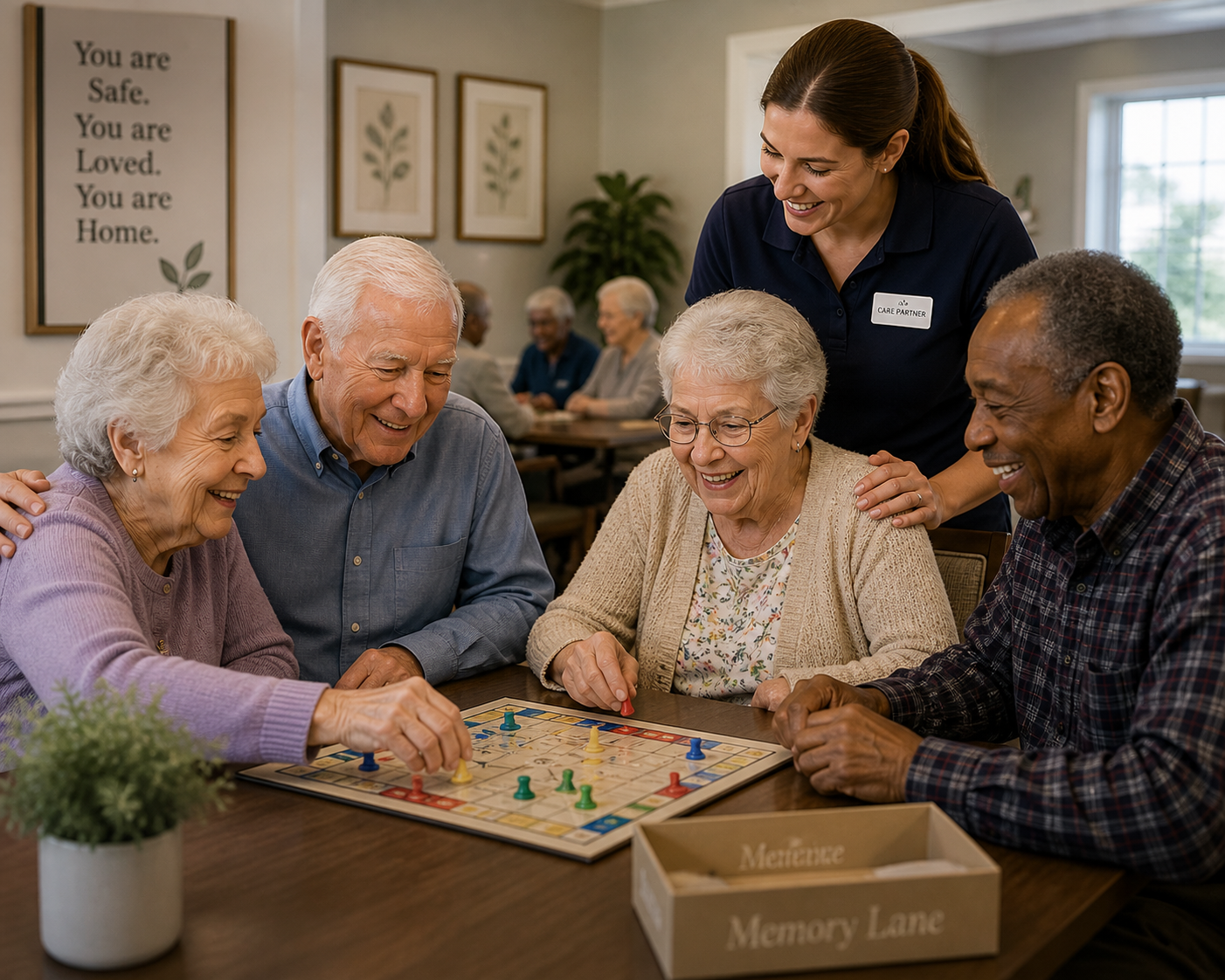
Simple Answer
People living in a memory care community often become deeply attached to the environment because it provides structure, familiarity, routine, and emotional safety. For someone living with dementia or Alzheimer’s, predictable surroundings can feel calmer and easier to process than the outside world.
I, personally, try to have a great time with the group when I visit. I try to “fit in” with the group and not impose at all. It’s a great time with great people…
and they don’t notice I tell the same corny jokes
The Moment That Catches Families Off Guard
It usually happens unexpectedly.
You take your parent out for lunch. Maybe back to their old home. Maybe to your house for the afternoon.
And then they ask to go back.
Back to the memory care community.
For many families, this feels confusing, painful, or even personal.
But most of the time, it has very little to do with love—and everything to do with comfort, routine, and cognitive stability.
After moving my father-in-law into Memory Care, I remember clearly the first time he asked to go back home.
We brought him to our house for a Labor Day bbq and he was clearly uncomfortable from the minute we left. During the bbq with many people whoo had spent considerable time with in the past, he was quiet.
He’d walk into the house during conversations.
He made a plate and started eating long before anyone else did.
Almost immediately after he finished, he asked me to take him back.
Memory Care Communities Are Designed Around Familiarity
Research has proven that consistency matters, especially with age related memory issues - especially dementia. This is the reason that a good memory care community is intentionally repetitive in the best possible way. The repetition is in the most important areas, including…
caregivers
meal routines
daily schedules
hallways
dining rooms
activities
For someone living with dementia, this consistency reduces stress and confusion.
Even when names or details are forgotten, emotional familiarity often remains.
That’s why someone may not remember a caregiver’s name… but still trust them deeply.
Why the Outside World Can Become Overwhelming
It’s not you! It’s part of their lives now
Families often assume that returning home will automatically feel comforting to their mom or dad. They think it’ll be just like the past, or even better because they haven’t been over in a while.
Your mom or dad will be ecstatic to be at your home and see everyone
You may be shocked or even upset, but you need to understand that
dementia changes how the brain processes environments.
Things that once felt normal can suddenly feel:
overstimulating
unfamiliar
unpredictable
mentally exhausting
Different layouts, noises, expectations, and routines can create anxiety quickly.
The memory care environment becomes easier to navigate because it is designed specifically around cognitive limitations..
My grandfather loved hot dogs. He’d always ask my dad for a “Good Shepherd hotdog” -
my dad has been in charge of the churches concession stand and they always had these huge, all-beef hotdogs for sporting events, festivals, etc.
After a few weeks at the Memory Care community he moved into, he came out to their house. My dad came out with one of those big, delicious hotdogs out to him and he quietly, but still politely said, “I’m good with just my water.”
Everyone looked around at each other in utter shock and, somewhat, heartbroken. This was the first time anyone had experienced this and it was just so unlike him to do.
Soon, we noticed other similar things and determined that it was not us, or even the hotdog, it was part of his disease and the right care that he was receiving.

The Tight-Knit Community Most People Don’t Expect
One of the most overlooked parts of memory care is the social environment. The bonds developed are not only out of necessity, but also out of shared experiences. The brain is a beautiful thing and is the most powerful of all of God’s designs. The resiliency of the brain and its ability to adapt produce residents who…
recognize one another emotionally
sit together every day
participate in activities together
share comfort in routines
These are not always traditional friendships in the way younger adults think about them. Instead, they are meaningful connections and are part of the mind’s way of adapting
For someone living with memory loss, meaningful familiarity matters tremendously.
Why They May Want to Return Quickly
It’s important for families to understand the reasoning behind their desire to leave. It’s about knowing the why:
The memory care community has become the place where their brain feels safest.
This is one reason many residents:
sleep better there
socialize more there
appear calmer there
Predictability lowers stress.
2. When stress lowers, confusion often lowers too
3. Lower confusions offers peace and comfort
My grandma was a die-hard St. Louis Cardinals fan and would try to watch every game. She often had issues doing and would call my dad claiming the game wasn’t on her TV. Every time, he’d correct her and walk her through how to get the television on the correct channel. This worked most of the time, but there were times when she couldn’t quite grasp it. When that happened, he’d drive to her house and, many times, bring her to my parents’ house to watch the game. Inevitably, by the end of the inning they were able to start watching, she’d want to go home again. It was only a short drive luckily, because she would call again by the end of the game and start the process over again.