How to Talk to Your Parents About Senior Living
This is one of the hardest conversations most families will ever have and it’s so important for your mom or dad to “buy in” to the idea.
To them, you’re not just talking about housing.
You’re talking about:
independence
aging
identity
fear
change
and the reality that life may be shifting.

That’s why these conversations often go badly - Not because families don’t care. Because everyone cares so much.
The Biggest Mistake Adult Children Make
Timing is key to these conversations. The same is true about many emotional conversations, but especially when it comes to this. Most conversations begin too late. Try to avoid starting the dialogue…
a fall
a hospitalization
worsening memory issues
or an emergency.
At that point, everyone is emotional and exhausted.
Sometimes, these conversations begin too early. Try to avoid starting the dialogue…
Do you know the science on why these conversations go poorly?
when you’re acting out of fear
there is nothing even in the planning stages
there are isolated incidents instead of patterns
your mom and dad is unable to see issues themself.
What Helps Instead
There isn’t a guide or a script, no matter what anyone tries to sell you. You know your mom or dad better than anyone. Surprisingly, once you’re planning to speak with them and sometimes as your speaking, it flows naturally. When I’ve helped to prepare for this conversation or have been told about it afterwards, some common things emerged:
Need some guidance, Start here…
Slowing down major decisions when possible
Focusing on communication
Letting people keep a few meaningful items
Accepting imperfection
Understanding that grief and logistics often happen together
Ask Questions Instead of Giving Orders
You need to make them feel part of the decision - maybe even have them think they made the decision.
Instead of: “You can’t live here anymore.”
Maybe try:
“How is living in the house been, does the house feel different?”
“Are stairs becoming harder?”
“What worries you most right now about being more forgetful?”
Questions reduce defensiveness.
Focus on Safety and Quality of Life
No one wakes up one day and says: Let’s move mom to memory care
You’re worried and make them know that you love them and are worried.”
Some good phrases are:
“We want life to feel easier and we’re not forcing anything. They’ll still have a say in this”
“This doesn’t have to happen immediately”
“Support and being around people your own age may help .”
This isn’t something you’re taking lightly and you’re looking out for them.
What NOT to Say
I have noticed that certain words or phrases are triggers for an argument or a parent to shut down. It’s best to avoid phrases like:
“You can’t handle this anymore.”
“You’re being stubborn.”
“You have to move.”
“This house is too much for you.”
Even if those thoughts are true emotionally, they often create resistance instead of progress.
Learn more about how these conversations usually go
Words Matter
People have stereotypes in their head about Senior Living Communities. Most of the time, these are wrong. To combat these, here is a list of words associated with Senior Living that are negative. I’ve put some alternatives to these words that steer the conversation more positive:
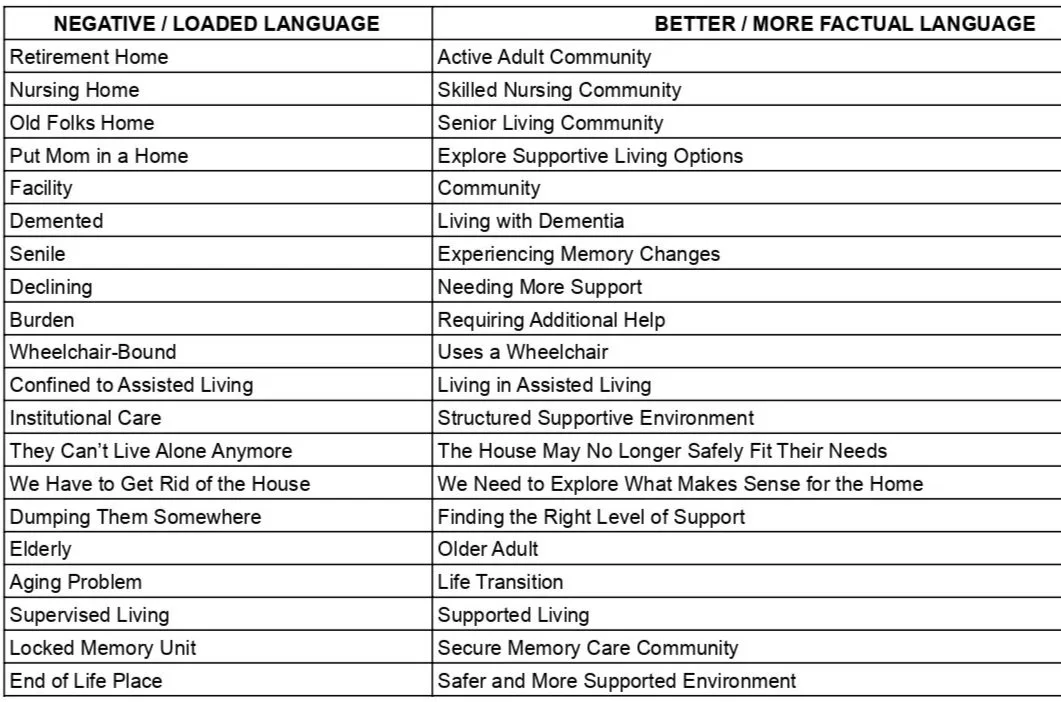
What Your Mom or Dad Is Actually Feeling
No matter how much your mom or dad sounds like they are disappointed, sad, blindsided, or even angry. The primary thing they are feeling is fear.
These other things are coming across because they fear:
losing control
losing their memories
becoming isolated
being treated differently
becoming a burden
Find out more about how they’re feeling